
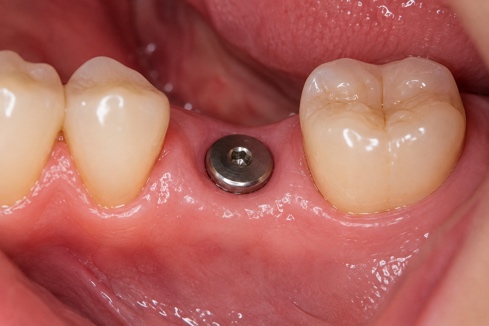
Dental implants can provide an excellent long-term solution for missing teeth.
But they are usually not an instant treatment.
From beginning to final crown, the process may take several months depending on the starting condition of the site.
Why Does Implant Treatment Take Time?
Unlike a traditional dental restoration, an implant relies on a biological connection between the implant surface and your jawbone.
After placement, the surrounding bone needs time to heal and integrate with the implant.
This is called osseointegration.
Step 1: Evaluation and Planning
Before treatment, your dentist evaluates factors such as:
- Available bone
- Gum health
- Space
- Bite
- Adjacent teeth
- Medical history
- Tooth position
Three-dimensional imaging may be used when appropriate to evaluate implant anatomy.
Step 2: Tooth Extraction, If Necessary
If the damaged tooth is still present, it may first need to be removed.
Depending on the condition of the site, several approaches are possible.
The implant may sometimes be placed immediately.
In other situations, the extraction site is allowed to heal first.
Step 3: Bone Grafting, If Needed
Not every implant requires bone grafting.
When adequate bone is not available, grafting may be performed:
- Before implant placement
- At the same time as implant placement
- At the time of extraction
The amount of grafting can substantially influence the timeline.
Step 4: Implant Placement
The implant fixture is surgically positioned in the jaw.
The implant then requires time to integrate with the bone.
Step 5: Healing and Osseointegration
This is one of the most important phases.
Even if the surgical area feels normal after a short period, the bone continues healing around the implant.
The implant should not necessarily be rushed into full function before adequate stability has developed.
Step 6: Final Restoration
After the implant is ready, impressions or digital scans can be used to fabricate the final restoration.
The implant is then restored with an abutment and crown.
Can You Get a Tooth the Same Day?
Sometimes a temporary tooth can be placed immediately.
This is known as immediate provisionalization or immediate loading in certain situations.
However, same-day teeth are not appropriate for every implant.
Factors include:
- Initial implant stability
- Bone quality
- Bite
- Implant position
- Esthetic demands
- Grinding habits
Why Shouldn’t the Process Be Rushed?
An implant can feel stable mechanically on the day it is placed, but the surrounding bone still needs to heal biologically.
Premature excessive forces can interfere with successful integration.
Does Implant Placement Hurt?
The surgical area is anesthetized during treatment, and postoperative discomfort varies with the complexity of the procedure.
Related: Are Dental Implants Painful? What to Expect
What If the Tooth Has Been Missing for Years?
Implants can often still be placed, but bone volume must be evaluated because the ridge can shrink after tooth loss.
Related: Can You Get a Dental Implant Years After Losing a Tooth?
Implant vs. Bridge Timeline
A traditional bridge can often be completed faster because it does not require osseointegration.
However, it generally relies on neighboring teeth for support.
Frequently Asked Questions
Can an implant be completed in one appointment?
The surgical implant may be placed in one appointment, but the complete tooth replacement often involves multiple stages.
Why do I need to wait after implant placement?
The surrounding bone needs time to integrate with the implant.
Does every extraction need months of healing before an implant?
No. Immediate implant placement may be appropriate in selected situations.
Does bone grafting make treatment longer?
It can, particularly when substantial grafting must heal before implant placement.
The Bottom Line
Dental implant treatment is often measured in months rather than days because successful treatment depends on biological healing.
At Chastain Dental Studio, we help patients throughout Chastain Park, Buckhead, Sandy Springs, and North Atlanta understand the complete timeline before treatment begins so there are no surprises between extraction, implant placement, healing, and the final crown.