You look in the mirror and notice one tooth suddenly appears longer than the others.
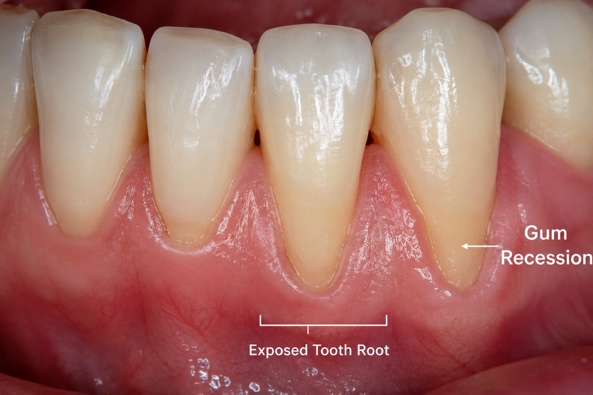
Or perhaps the yellowish root surface near the gumline is becoming visible.
You may be experiencing gum recession.
What Is Gum Recession?
Gum recession occurs when the edge of the gum tissue moves away from its original position and exposes more of the tooth root.
Recession can affect one tooth, several teeth, or large portions of the mouth.
Does Recession Automatically Mean Gum Disease?
No.
Periodontal disease is one important cause, but recession can occur for several reasons.
Possible contributors include:
- Periodontal disease
- Aggressive brushing
- Thin gum tissue
- Tooth position
- Orthodontic movement
- Grinding or clenching
- Trauma
- High muscle or frenum attachment
- Natural anatomical differences
Can Brushing Too Hard Cause Recession?
Aggressive brushing may contribute to recession in susceptible areas.
Using excessive pressure does not necessarily clean teeth better.
A soft-bristled toothbrush and proper technique are usually preferred.
What Role Does Periodontal Disease Play?
Periodontitis can destroy supporting tissue and bone around teeth.
As those structures are lost, recession may become increasingly visible.
Related: What Happens If Gum Disease Goes Untreated?
Why Do Receding Gums Cause Sensitivity?
The root surface is not covered by the same thick enamel that protects the crown of the tooth.
When the root becomes exposed, cold temperatures and other stimuli can more easily reach sensitive dentin.
Related: Why Are My Teeth Sensitive to Cold and Hot?
Can Recession Grow Back Naturally?
In most cases, significantly lost gum tissue does not simply grow back to its original position.
However, the underlying cause can often be addressed to help prevent further progression.
Certain patients may benefit from periodontal grafting procedures.
Does Every Receding Gum Need a Graft?
No.
Treatment depends on:
- Severity
- Progression
- Sensitivity
- Root exposure
- Tissue thickness
- Esthetic concerns
- Tooth position
- Oral hygiene
- Periodontal health
Some areas can be monitored.
Can Grinding Contribute?
Excessive bite forces may contribute to cervical tooth changes and may coexist with recession, although recession usually has multiple contributing factors.
Related: Do I Need a Nightguard? Signs You Grind Your Teeth at Night
Frequently Asked Questions
Will my tooth fall out because my gum receded?
Recession alone does not necessarily mean the tooth is unstable. Bone support is an important separate factor.
Can sensitive toothpaste help?
Yes, desensitizing products can help some exposed root surfaces.
Should I brush the receded area?
Yes, but gently. Plaque still needs to be removed.
Can gum grafting cover an exposed root?
In selected cases, periodontal grafting can improve coverage and tissue thickness.
The Bottom Line
Gum recession is a finding, not a diagnosis.
At Chastain Dental Studio, we first determine why the recession is occurring before deciding whether it should simply be monitored or actively treated. For patients throughout Chastain Park, Buckhead, Sandy Springs, and North Atlanta, preserving healthy gum tissue begins with identifying the underlying cause.