
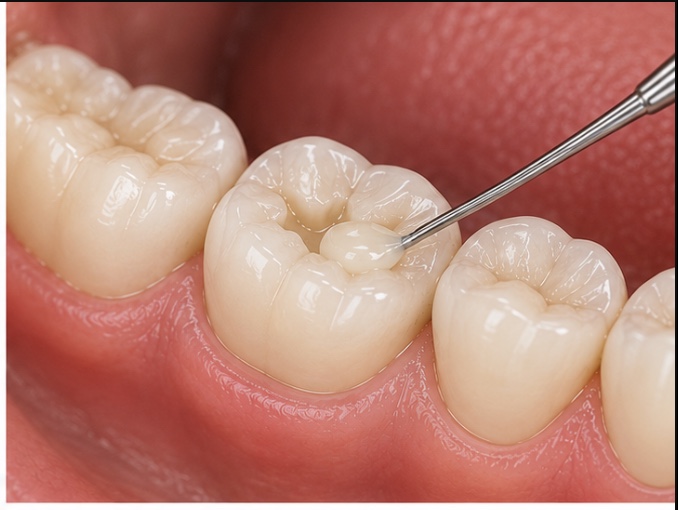
If you have a filling that’s been in your mouth for ten or fifteen years, you may wonder whether it needs to be replaced simply because it’s old.
The answer is usually no.
Dental fillings do not come with an automatic expiration date.
Some restorations fail relatively early, while others remain functional for decades.
What Determines How Long a Filling Lasts?
Several factors influence longevity:
- Size of the filling
- Location in the mouth
- Amount of healthy tooth remaining
- Filling material
- Bite forces
- Grinding or clenching
- Oral hygiene
- Cavity risk
- Diet
- Whether cracks develop around the restoration
A tiny filling and a restoration replacing half of a molar are not mechanically equivalent.
Does an Old Filling Automatically Need Replacement?
No.
Replacing a sound filling unnecessarily removes additional tooth structure.
At Chastain Dental Studio, age alone is not enough reason to replace an otherwise healthy restoration.
Related: Should Old Silver Amalgam Fillings Be Replaced?
How Do Fillings Fail?
Common problems include:
- New decay around the filling
- Fracture of the restoration
- Fracture of the tooth
- Open margins
- Wear
- Food trapping
- Sensitivity
- Loss of the filling
If your filling falls out entirely, the tooth should be evaluated.
Can a Large Filling Become a Crown?
Sometimes.
As a filling becomes larger, there is less natural tooth structure available to withstand chewing forces.
If the remaining tooth becomes weak or cracked, a crown may provide better protection than repeatedly enlarging the filling.
Related: Crown vs. Filling: How Do You Know Which One You Need?
What Role Does Grinding Play?
Grinding and clenching place repetitive forces on teeth and restorations.
That can contribute to wear, fractures, and cracked tooth structure.
Related: Do I Need a Nightguard? Signs You Grind Your Teeth at Night
Frequently Asked Questions
How many years should a filling last?
There is no universal number. Longevity depends heavily on the filling’s size, location, material, bite, and condition of the surrounding tooth.
Should I replace a filling after ten years?
Not simply because it is ten years old.
How can I tell whether a filling is failing?
You may experience sensitivity, roughness, food trapping, chewing discomfort, or notice part of the restoration missing—but some failures are detected before symptoms develop.
The Bottom Line
Dental fillings should be evaluated based on their condition, not their birthday.
At Chastain Dental Studio, we prefer to preserve healthy tooth structure whenever possible and replace restorations when there is a clinical reason to do so.