
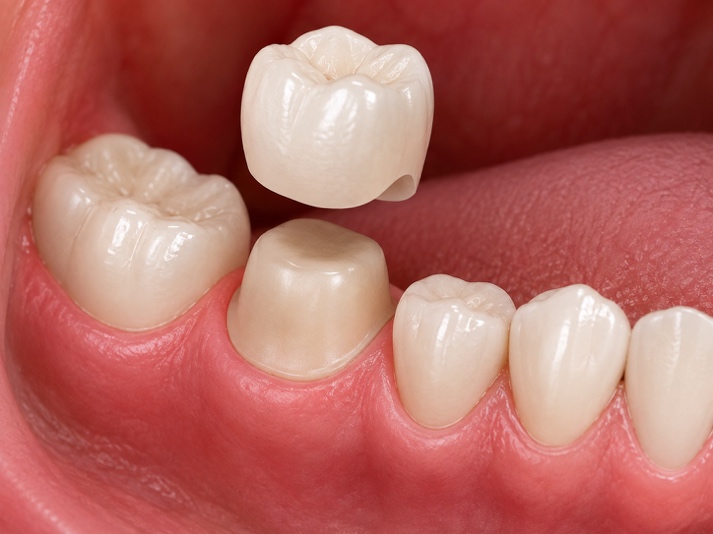
Hearing that you need a crown can sometimes feel like a major jump—especially if the tooth doesn’t hurt.
So how does a dentist decide when a filling is no longer enough?
What Does a Crown Actually Do?
A dental crown covers and protects a significant portion of the visible tooth.
Unlike a filling, which replaces a localized area of missing tooth structure, a crown can help reinforce weakened cusps and protect a tooth that has lost substantial structure.
Why Might a Dentist Recommend One?
Common reasons include:
- Very large existing filling
- Fractured tooth structure
- Significant decay
- Cracked cusps
- Extensive wear
- Limited remaining healthy tooth
- Certain root canal-treated teeth
- Replacing a failing crown
- Restoring an implant
Filling vs. Crown
The decision often comes down to how much reliable natural tooth structure remains.
If the tooth still has strong walls and the damaged area is relatively limited, a filling may be appropriate.
If large portions of the tooth are missing or weakened, another large filling may place the remaining tooth at risk.
Related: Crown vs. Filling: How Do You Know Which One You Need?
Does a Cracked Tooth Automatically Need a Crown?
Not every crack is the same.
Small superficial craze lines can be harmless.
A deeper crack involving a functional cusp may require protection.
Related: Cracked Tooth: Symptoms, Treatment, and When It Becomes an Emergency
What About Huge Old Fillings?
A tooth with a very large restoration may have only thin walls of enamel and dentin remaining.
Those walls can eventually fracture under chewing forces.
Related: Should Old Silver Amalgam Fillings Be Replaced?
Can You Wait?
Sometimes monitoring may be reasonable.
Other times, waiting increases the risk that a repairable tooth fractures in a way that becomes much more difficult—or impossible—to restore.
That decision should be individualized.
Related: What Happens If You Don’t Get a Crown When Your Dentist Recommends One?
Frequently Asked Questions
Does needing a crown mean my tooth is bad?
No. Crowns are often used because a tooth has lost enough structure that it would benefit from additional protection.
Can I get another filling instead?
Sometimes. The answer depends on how much healthy tooth remains and where the forces are concentrated.
Does every root canal tooth need a crown?
Not automatically. Tooth location and remaining structure matter.
The Bottom Line
A crown should have a structural reason behind it.
At Chastain Dental Studio, our goal is to explain what portion of the tooth is compromised, why a filling may or may not be sufficient, and whether monitoring is a reasonable alternative.