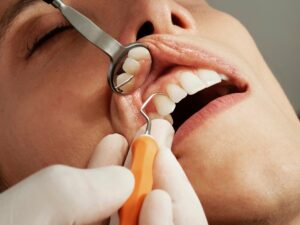
Patients are sometimes surprised when they come in expecting a routine cleaning and are told they may need a deep cleaning instead.
That naturally raises an important question:
What is the actual difference between a regular cleaning and a deep cleaning?
The distinction is not simply that one cleaning removes “more tartar.” The two procedures are intended to treat different periodontal conditions.
At Chastain Dental Studio, we base the recommendation on the health of the gums and supporting bone rather than automatically assigning a particular cleaning based on how long it has been since your last dental visit.
What Is a Regular Dental Cleaning?
A routine preventive cleaning—often called a prophylaxis—is generally intended for a patient whose periodontal tissues are fundamentally healthy or who has mild gingival inflammation without significant periodontal attachment or bone loss.
During a regular cleaning, your hygienist removes plaque, tartar, and surface stain from the teeth.
This is preventive care designed to help maintain health.
What Is a Deep Cleaning?
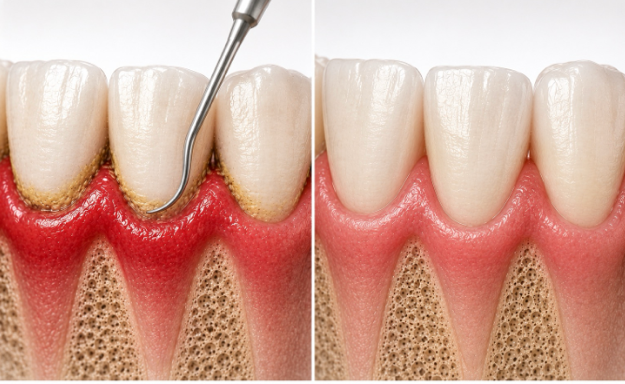
A deep cleaning is commonly known as scaling and root planing, or SRP.
It is generally recommended when periodontal disease has resulted in deeper pockets, inflammation, attachment loss, or bone loss around the teeth.
The goal is to remove bacterial deposits from below the gumline and along root surfaces where a routine cleaning may not adequately address the disease.
Related: Why Is My Dentist Recommending a Deep Cleaning?
Why Are Gum Measurements Important?
During a periodontal evaluation, your hygienist or dentist may gently measure the space between the gum and tooth.
These measurements are commonly called pocket depths.
Healthy gum tissue generally forms a relatively shallow space around the tooth. As periodontal disease progresses, deeper pockets can develop.
However, the number alone does not tell the entire story.
Dentists also consider:
- Bleeding
- Inflammation
- Gum recession
- Attachment loss
- Tartar below the gums
- Bone levels on X-rays
- Tooth mobility
- Previous periodontal history
Is Bleeding Enough to Need a Deep Cleaning?
Not necessarily.
Gingivitis can cause significant bleeding even when there has been no permanent bone loss.
That is why a periodontal diagnosis should be based on the full clinical picture rather than bleeding alone.
Related: Can Gum Disease Be Reversed?
Why Can’t You Just Do a Regular Cleaning First?
If significant periodontal disease is present, performing only a routine cleaning may fail to adequately treat deposits below the gumline.
This is similar to treating the visible portion of the problem while leaving the deeper disease process unaddressed.
However, the opposite is also true:
A patient should not automatically receive scaling and root planing simply because there is heavy tartar.
The diagnosis matters.
Does a Deep Cleaning Hurt?
Local anesthetic can be used to keep the area comfortable during treatment.
Some patients experience mild tenderness or sensitivity afterward, particularly when significant inflammation or tartar was present.
Symptoms generally improve as tissues heal.
What Happens After a Deep Cleaning?
Periodontal disease requires ongoing maintenance.
After scaling and root planing, the gums are typically reevaluated to determine how well they responded.
Many patients with a history of periodontal disease benefit from periodontal maintenance visits at intervals more frequent than traditional six-month preventive visits.
Related: What Happens If Gum Disease Goes Untreated?
Frequently Asked Questions
Is a deep cleaning just a more thorough regular cleaning?
No. It is generally a periodontal treatment intended for disease below the gumline.
Does everyone with tartar need SRP?
No. Tartar quantity alone does not establish a periodontal diagnosis.
Can I go back to regular cleanings afterward?
Patients with a history of periodontitis are frequently maintained with periodontal maintenance rather than traditional prophylaxis.
Why does my insurance classify the two procedures differently?
They are different clinical services performed for different diagnoses.
The Bottom Line
A regular cleaning helps maintain periodontal health.
A deep cleaning is intended to treat periodontal disease.
At Chastain Dental Studio, we evaluate pocket depths, inflammation, attachment levels, bone support, and your overall periodontal condition before deciding which type of care is appropriate. For patients in Chastain Park, Buckhead, Sandy Springs, and North Atlanta, the goal is to recommend the cleaning that matches the actual condition of the gums—not simply the most aggressive option.