Gum disease can be deceptive.
Unlike a cracked tooth or severe toothache, periodontal disease may progress for years without creating dramatic pain.
That does not mean it is harmless.
Gum Disease Begins With Inflammation
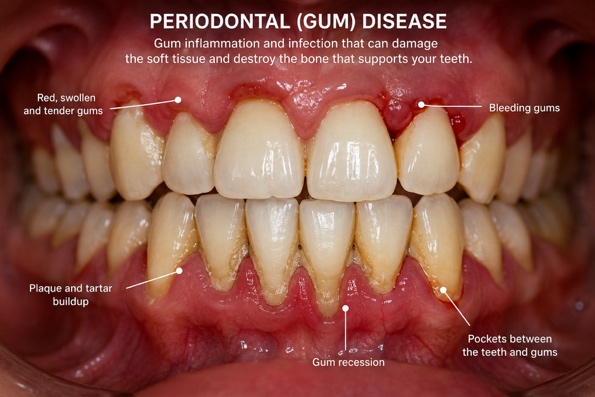
Plaque accumulating around the gumline can irritate the tissues and cause gingivitis.
At this early stage, symptoms may include:
- Bleeding
- Swelling
- Redness
- Tenderness
- Bad breath
Gingivitis can often be reversed when the inflammation is controlled.
Related: Can Gum Disease Be Reversed?
What Happens When It Progresses?
In susceptible patients, inflammation can move beyond the superficial gum tissues and affect the structures that support the teeth.
This is periodontitis.
Periodontitis can lead to progressive loss of attachment and bone around teeth.
Deeper Periodontal Pockets
As supporting tissue is lost, the space between the tooth and gum can deepen.
These pockets can become difficult to clean at home.
That creates an environment where additional plaque and tartar can accumulate below the gumline.
Gum Recession
Gum recession can expose portions of the tooth root.
This may cause:
- Increased sensitivity
- Longer-looking teeth
- Greater risk of root decay
- Cosmetic concerns
Related: Why Are My Gums Receding?
Bone Loss
Bone supports the roots of the teeth.
When periodontal inflammation causes enough bone loss, teeth may begin losing stability.
This can eventually result in mobility.
Teeth Can Shift
Advanced periodontal disease can change the way teeth are supported.
Patients may notice:
- New spaces between teeth
- Front teeth flaring
- Bite changes
- Teeth becoming loose
Can Periodontal Disease Cause Tooth Loss?
Yes.
Advanced untreated periodontal disease is one of the major causes of tooth loss in adults.
But progression is not inevitable.
Proper diagnosis, treatment, and maintenance can help many patients keep their natural teeth.
Why Doesn’t It Always Hurt?
Periodontal disease frequently progresses without stimulating the nerve inside a tooth.
That means significant destruction can occur without traditional toothache symptoms.
This is why relying on pain alone can be misleading.
Related: How Do I Know If I Have Gum Disease?
What Treatment Might Be Recommended?
Depending on severity, care may include:
- Improved home hygiene
- Scaling and root planing
- Periodontal maintenance
- Risk-factor modification
- Referral to a periodontist when appropriate
Related: Why Is My Dentist Recommending a Deep Cleaning?
Frequently Asked Questions
How fast does gum disease progress?
Progression varies substantially between individuals and even between different teeth in the same person.
Will my teeth immediately become loose?
No. Mobility generally occurs after significant supporting tissue has been lost.
Can treatment stop the disease?
Periodontal therapy can often control disease activity and help prevent or slow additional destruction.
Can lost gum and bone grow back?
Some regenerative procedures are possible in selected cases, but lost tissue does not automatically regenerate.
The Bottom Line
Periodontal disease is usually easier to manage before extensive supporting tissue has been lost.
At Chastain Dental Studio, we evaluate gum health before symptoms become severe. For patients in Chastain Park, Buckhead, Sandy Springs, and North Atlanta, our goal is to identify periodontal disease early enough to preserve as much natural support around the teeth as possible.