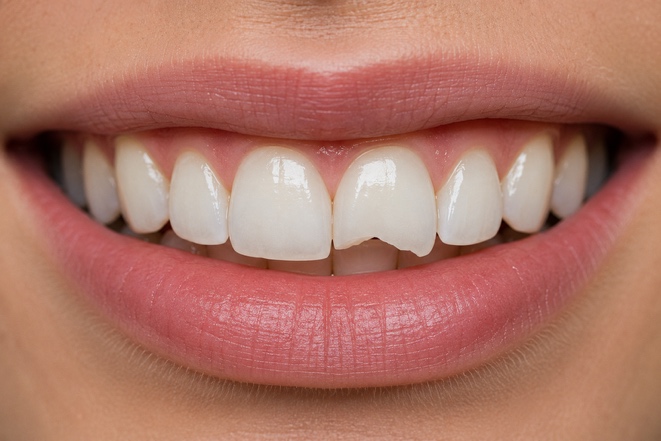
You bite into something hard and suddenly feel a sharp edge.
Or perhaps you notice a piece of tooth has broken away.
What should you do?
First, Look at the Size of the Damage
A chipped tooth can range from a tiny enamel defect to a major fracture involving the nerve or root.
If possible, examine the area without aggressively touching or probing it.
Save the Broken Piece
If you can find the fragment, save it.
Rinse it gently with water and bring it to the dental appointment.
In selected situations, a tooth fragment may even be useful during treatment.
Rinse Your Mouth
Gently rinse with water to remove debris.
If there is bleeding from the surrounding tissue, clean gauze can be used with gentle pressure.
Avoid Chewing on That Tooth
The remaining tooth structure may be weakened.
Avoid:
- Ice
- Hard candy
- Nuts
- Very crunchy foods
- Chewing directly on the damaged tooth
Why Do Teeth Break?
Common causes include:
- Large existing fillings
- Cavities
- Grinding
- Clenching
- Trauma
- Biting hard foods or objects
- Existing cracks
- Natural wear
Related: Cracked Tooth: Symptoms, Treatment, and When It Becomes an Emergency
What Treatment Might Be Needed?
Treatment depends on the amount of damage.
Possible options include:
- Smoothing a tiny rough edge
- Composite bonding
- Filling
- Veneer in selected cosmetic cases
- Crown
- Root canal treatment when the nerve is involved
- Extraction when damage is too extensive to restore
Small cosmetic chips can sometimes be treated very conservatively.
When Is a Crown Needed?
If a substantial portion of a back tooth fractures, there may not be enough reliable tooth structure for another filling.
A crown can provide broader protection.
Related: Crown vs. Filling: How Do You Know Which One You Need?
When Is a Broken Tooth an Emergency?
Prompt attention is particularly important when there is:
- Severe pain
- Significant bleeding
- Trauma
- A large fracture
- Exposed inner tooth structure
- Swelling
- Signs of infection
What If the Tooth Doesn’t Hurt?
Pain does not determine whether the tooth is structurally stable.
A large fracture may be painless but still require treatment to prevent additional damage.
Frequently Asked Questions
Can a chipped tooth repair itself?
No. Lost enamel does not biologically grow back.
Does every chip need a crown?
No. Many small chips can be treated much more conservatively.
Can bonding repair a front tooth?
Often, yes, depending on the size and bite.
Can I wait if the tooth isn’t painful?
Small superficial chips may not be urgent, but larger structural fractures should be evaluated.
The Bottom Line
A chipped tooth can be anything from a minor cosmetic issue to a significant structural problem.
At Chastain Dental Studio, we evaluate how much tooth structure remains and choose the least invasive predictable treatment. For patients throughout Chastain Park, Buckhead, Sandy Springs, and North Atlanta, protecting the tooth early can sometimes prevent a small fracture from becoming a much larger one.